Leo’s Lesson Six 🐾
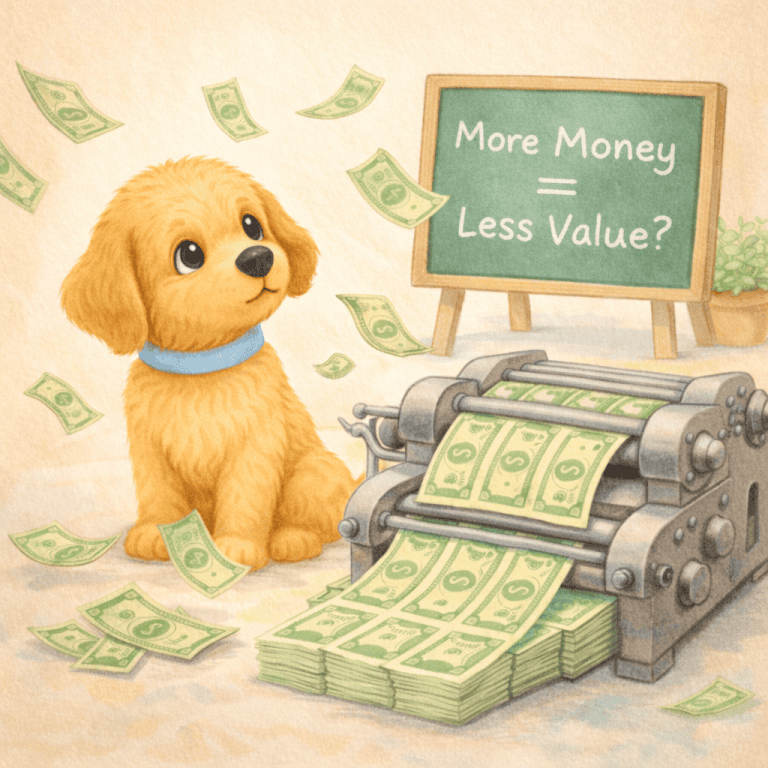
After learning about the money supply, Leo had another question…who controls money? In his last lesson, Leo discovered something surprising…when more money is printed, each dollar becomes worth a little less. That means the supply of money really does matter!
But that discovery led Leo to an even bigger question…
If the supply of money matters so much, who actually decides how much money exists? Who’s in charge? What happens when the people in charge make decisions that affect everyone?
Those questions led Leo to one of the most important lessons of his entire journey…so who controls money?
Someone is Always in Charge of Money
Leo thought about his neighborhood.
In Leo’s world, every dog uses bones for money. But who makes the rules about trading? Who controls money and decides if more bones should be created?
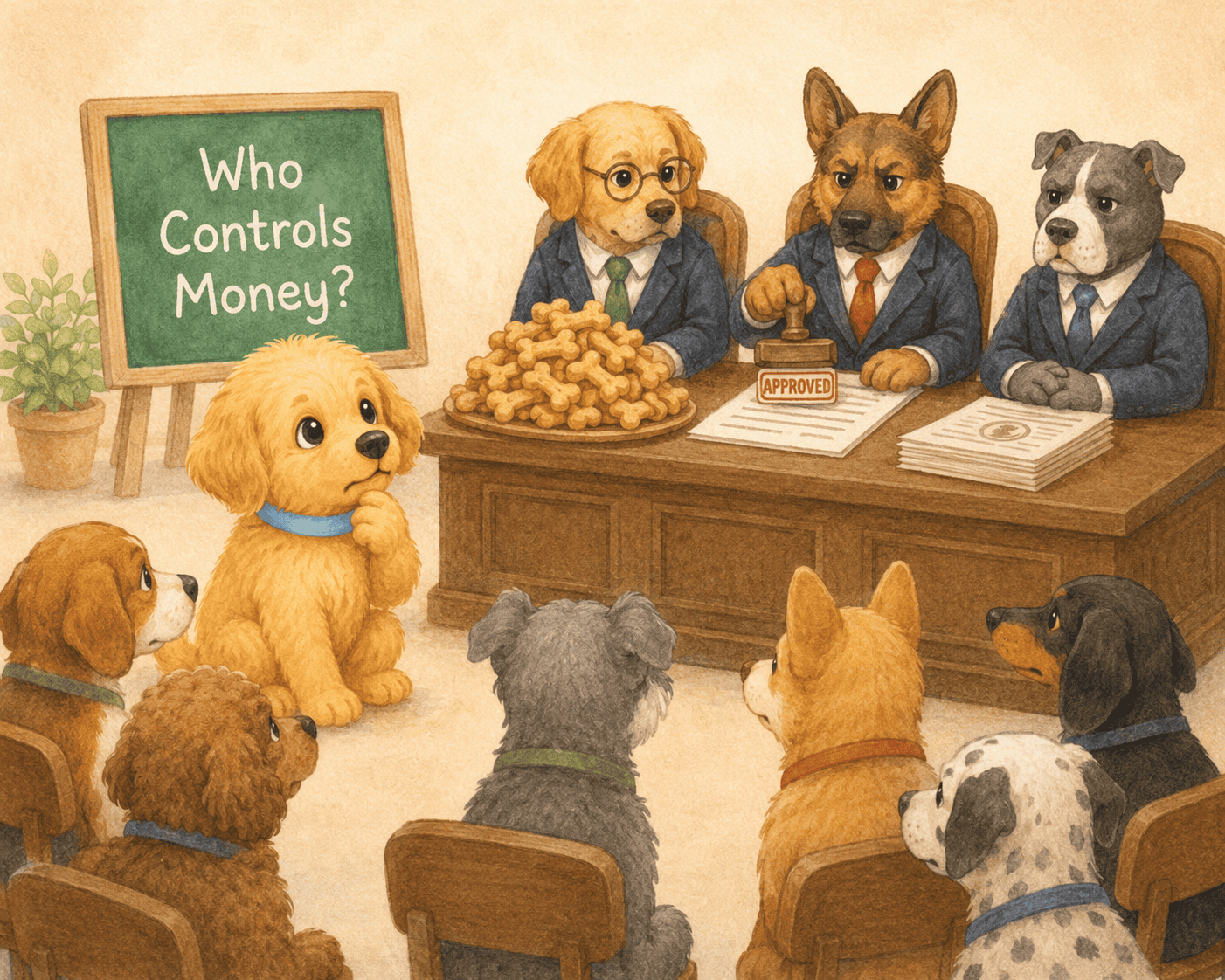
In Leo’s neighborhood, there was a dog council. The council was made up of the oldest and most respected dogs in the area. They met regularly to discuss the bone supply. They decided when to create more bones. They set the rules for trading and made sure the bone system kept running smoothly.
Most dogs trusted the council. After all, they had been doing this for a long time and things generally worked out fine. Dogs didn’t question it.
But then Leo started wondering something important…
What if the council made a mistake? What if they created too many bones? What if their decisions helped some dogs more than others? Who decided who got to be on the council in the first place?
These are exactly the questions that real economists, families, and everyday people ask (or should ask!) about the people who control our money today!
Who Controls Money in the Real World?
In the real world, money is controlled by two main types of institutions working together.
1. Central Banks
A central bank is like Leo’s neighborhood dog council, but for an entire country. In the United States, the central bank is called the Federal Reserve, or “the Fed.”
The Federal Reserve has enormous power over money. These people decide:
- How much money exists in the economy
- How easy or difficult it is to borrow money
- What interest rates will be for families and businesses
- When to create more money and when to slow things down
The Federal Reserve is not a government department, but it works closely with the government. Its decisions affect every single person who uses dollars, whether they know it or not.
When the Federal Reserve creates more money, as we learned in Lesson Five, inflation can happen. When it makes borrowing more expensive, families find it harder to buy homes or start businesses. Its decisions affect the entire economy and impact everyone’s lives in very real ways.
2. Commercial Banks
Commercial banks are the banks most families use every day. Banks like Chase, Bank of America, and your local community bank.
These banks do something interesting that most people never learned about in school…
When you deposit money in a bank, the bank does not simply keep it safe in a vault…it lends most of it out to other people! This means that at any given moment most of the money in a bank account does not actually exist as physical cash. It exists only as numbers on a screen.
This system is called fractional reserve banking. It means that banks keep only a fraction of deposits as actual cash and lend the rest out to earn interest (meaning they make money off of your money!).
Leo found this surprising. The money families work hard to save is being used by banks to make more money for themselves. Most families never knew this was happening. These entities are who controls money in the U.S.
A Simple Leo Story
Leo imagined a neighborhood bone bank run by a very friendly and well-meaning dog named Banks.
Every dog in the neighborhood deposited their extra bones with Banks for safekeeping. He gave each dog a piece of paper saying how many bones they had on deposit.
But Banks had a secret. He didn’t keep all the bones in his vault. He lent most of them out to other dogs who needed bones right away. He charged those dogs a small fee for borrowing and kept the fee for himself.
Most of the time this worked perfectly fine. Dogs came to get their bones and Banks always had enough. Life felt normal and everyone trusted the system.
But one day, there was a big sale and many dogs decided they wanted their bones back at the same time. Banks suddenly realized he did’t have enough bones in the vault to give everyone what they were owed.
This is called a “bank run” and it has happened many times throughout history in the real world.
Leo sat quietly thinking about this for a while.
The bones that dogs thought they had and let Banks hold on to for safekeeping weren’t actually there. They existed only on paper. They existed as trust, but not as real bones in a real vault.
That felt like something worth really understanding.
Is This Good or Bad?
Leo wanted to be fair about this because fairness matters to him.
Central banks and commercial banks do many helpful things. They:
The banking system as we know it has supported economic growth and has helped billions of people over many decades, but it also has real limitations that are worth understanding honestly:
Leo isn’t saying the banking system is bad. Leo is just making sure everyone knows that it’s worth understanding, because understanding how money works is the first step to making smart decisions and being confident about your own financial future. Leo finally understands who controls money in his world.
Why Does This Matter for Families?
Leo thought about everyday families working hard, saving carefully, and trusting in the system.
Most families never learn about central banks or fractional reserve banking. Most families just deposit their money, pay their bills, and hope things work out.
But what if understanding how the system works could help families make better decisions?
What if knowing that more money can always be created helps families think differently about how and where they save?
What if understanding who controls money helps families to ask better questions about their financial future?
Leo believes knowledge is one of the most valuable things a family can have. Not to be angry or afraid, but to be informed, prepared, and confident.
When you understand who controls money you can begin to ask the most important question of all…
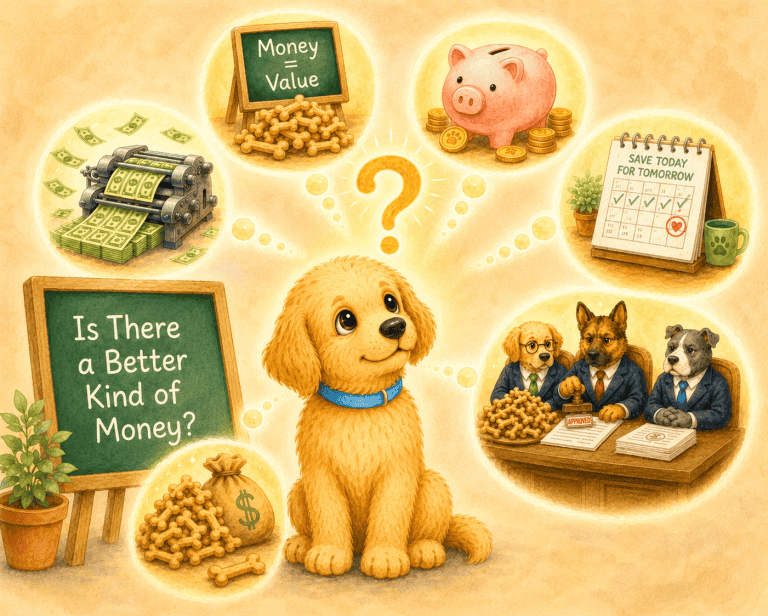
Is there another or better way?
That question is exactly where Leo’s next lesson and true journey begins.
Talking About Banks and Money Control as a Family
These concepts might feel big, but they don’t have to be complicated. Here are some simple ways to start the conversation at home:
Do you know what a bank does with the money you put in it?
Who do you think should be in charge of deciding how much money exists?
Does it surprise you that a small group of people makes decisions that affect everyone’s money?
If you could design a money system, what rules would you give it?
There are no wrong answers. These are simply invitations to think more carefully about something that affects every family every single day: who controls money.
Looking Back…
Leo now understands:
- What money is and why it exists
- How money measures value
- Why trust makes money work
- Why saving today helps us tomorrow
- Why the supply of money matters for everyone
- Who controls money and why that matters for families
But Leo still has his biggest question yet…
If money is controlled by people (or dogs) who can change the rules, create more of it, and make decisions that affect everyone, is there a kind of money that works differently?
Is there a kind of money that no one controls?
That question leads Leo to his most exciting discovery yet…
Until then, Leo keeps doing what he does best…
Being curious, asking questions, and learning one lesson at a time.
Want to follow Leo on his journey? Read Leo’s First Bitcoin! and download the free Parent and Educator Guide at LeoThePuppy.com 🐾