Leo’s Lesson Five 🐾
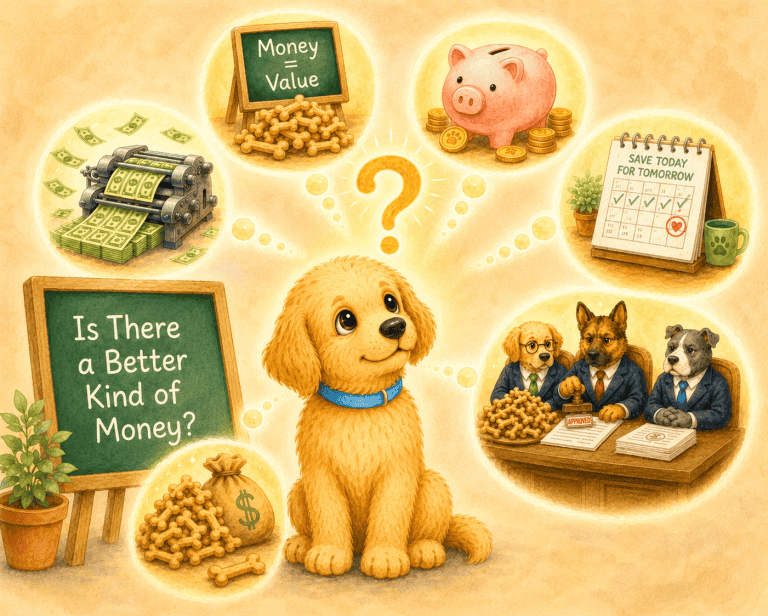
If saving is about the future, shouldn’t we think about whether our money will still be worth something when we need it? Why can’t we just increase the money supply?
In the last lesson, Leo learned why we save money and how saving is really about planning for tomorrow, but that lesson left Leo with a big question: if money can lose its value over time, does it matter how much money exists?
That question led Leo to one of the most important and fascinating discoveries of his journey…
Why Does the Amount of Money Matter?
Leo started thinking about something simple.
Imagine there are only 10 bones in the whole world. Every dog wants one. Those bones are valuable because they are rare and hard to find. This is also referred to as scarcity (it means there is a limited supply of something).
Now imagine someone suddenly created 1,000 more bones overnight. Suddenly bones are everywhere. Does each bone feel as special anymore? Does each bone feel as valuable? Nope.
That’s exactly how our money supply works.
The supply of money simply means how much money exists in the world at any given time. The amount of money that exists has a big effect on how much that money is worth.
What Happens When There’s Too Much Money?
Leo noticed something interesting in his earlier lessons…
When Leo’s dad explained that money doesn’t buy as much as it used to, Leo wondered why. Now Leo is beginning to understand the answer. When there’s more money in the world, but the same amount of things to buy:
This is called inflation and we explored it in Leo’s Lesson Two. But now Leo understands why inflation happens. One of the biggest reasons is simply that more money was created (that’s affects our money supply!).
Think of it this way…if everyone in a town suddenly received an extra $1,000, they would all rush to the store to buy things, but the store only has the same amount of things as before. The store owner would raise prices because everyone has more money to spend. Suddenly that extra $1,000 does not feel like as much as it did before.
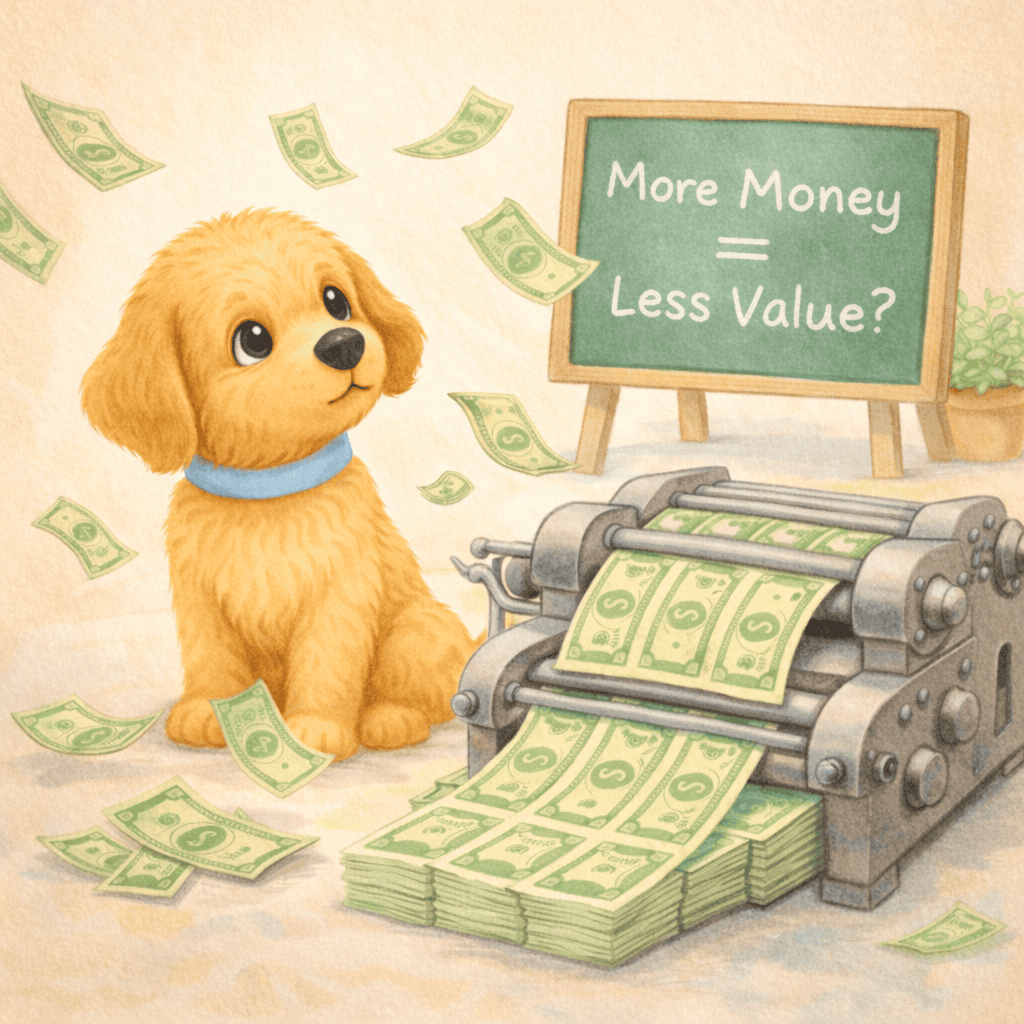
More money does not always mean more value. It can actually mean less!
Who Controls How Much Money Exists?
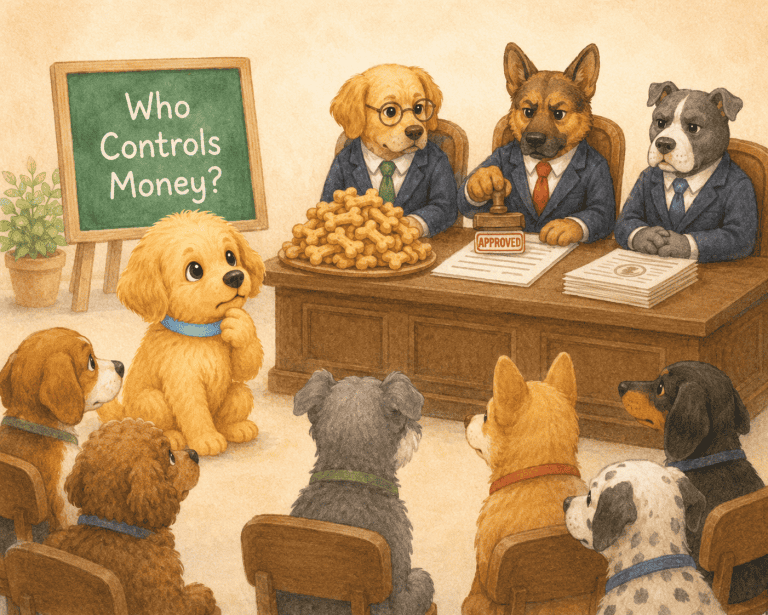
Leo had another question: if the money supply affects how much our money is worth, who decides how much money to create?
That’s a great question! In most countries today, the amount of money is controlled by governments and central banks. These are the organizations that decide when to print more money or just create more of it digitally by making the number bigger.
Sometimes they do this for good reasons like during a crisis or in an emergency, but sometimes creating too much money too quickly causes problems for everyone, especially people who have been saving carefully and for a long time!
When more money is created:
Leo thought that seemed a little unfair…and he was right!
A Simple Leo Story
Leo imagined a neighborhood where every dog received exactly 10 bones each week to trade for food and toys.
Everyone knew what things cost: a squeaky toy cost 2 bones and a bag of dog food cost 5 bones. Life was predictable and fair.
Then one week, every dog received 20 bones instead of 10. At first, everyone was happy! More bones! But then, something strange happened. The store owner noticed everyone had more bones to spend and raised the prices.
Suddenly, having 20 bones did not seem much better than having 10 bones before. More bones did not mean more value…it just meant higher prices for the same things.
Leo realized something important…it isn’t just about how much money you have…it’s about how much your money is actually worth.
What Makes a Good Money Supply?
Leo learned that the best kind of money has a supply that is:
Predictable so that everyone knows how much exists and how much will ever exist
Limited so it cannot be created endlessly without consequences
Trustworthy so people can plan for the future without worrying that the rules will suddenly change
When money has these qualities, people can save confidently, plan ahead, and trust that their hard work today will still have value tomorrow.
When money doesn’t have these qualities, saving becomes harder, planning becomes uncertain, and the future feels less safe.
Why This Matters for Families
Leo thought about families and how hard people work to earn and save money.
Imagine working hard every day, saving smartly every week, and then discovering that your savings buys less than they used to just because more money was added.
That can feel pretty discouraging.
But here’s the good news….understanding why this happens is the first step to making smarter decisions about how and where to save.
When families understand the money supply they can:
Leo loves asking better questions..and so can you and your family.
Talking About Money Supply as a Family
This might seem like a big concept but it doesn’t have to be complicated at all. Here are some simple ways to start the conversation at home now that you have the answers:
Have you ever noticed that something costs more than it used to?
If everyone suddenly had a lot more money, what do you think would happen to prices?
Do you think it matters how much money exists in the world?
These simple questions can open up wonderful conversations that help children begin to think critically about money from a very early age.
Looking Back…
Leo now understands:
But Leo still had one more curious thought…if the money supply matters so much, what would happen if there was a kind of money whose supply could never be changed? A kind of money with a fixed and predictable supply that nobody could ever increase?
That question leads Leo to his next lesson…and it might be the most exciting one yet!
Until then, Leo keeps doing what he does best:
🐾 Being curious, asking questions, and learning one lesson at a time.